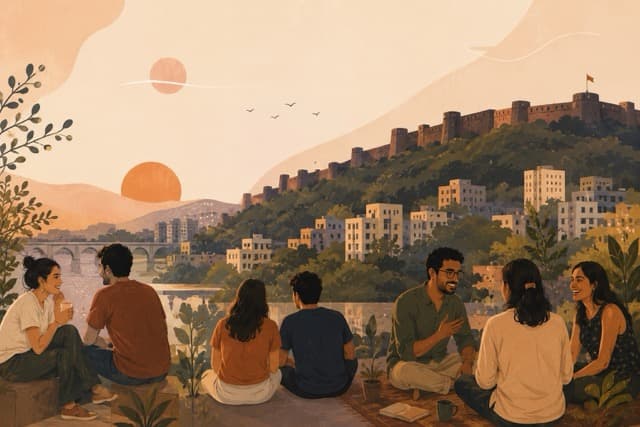
You have been in Pune for four months. You have a job, a flat in Wakad or Baner or somewhere off Nagar Road, and a WhatsApp group of colleagues you get along with fine. And on Saturday afternoon there is nobody you can text to ask if they want to get a coffee.
This is one of the most common experiences in the city and one of the least talked about. Pune takes in tens of thousands of people a year, mostly for work, mostly between twenty two and thirty five, mostly arriving alone. Almost all of them go through some version of the same six months.
This guide covers why it is harder than it should be, where people actually meet each other in this city, what to do about the part where you have to walk into a room alone, and how to turn a pleasant evening into an actual friendship. Yaranaa is one option in here. It is not the only one, and for plenty of people it will not be the right one.
The short version
- The bottleneck is almost never likeability. It is repetition. You need to see the same people more than once.
- Anything that meets on a schedule beats anything that meets once. A weekly class beats a big one off event, every time.
- The first message after meeting someone is the single highest leverage thing you can do, and almost nobody sends it.
- Expect three to six months. Everyone underestimates this and quits at week five.
Why this is genuinely hard, and not your fault
Sociologists have a fairly boring answer for how friendships form, and it has held up for decades. Three ingredients: proximity, repeated unplanned interaction, and a setting where people let their guard down. College hands you all three for free. You live near the same people, you bump into them whether you planned to or not, and you are all equally clueless.
Adult life removes all three. You commute past people rather than living among them. Every interaction is scheduled, which means every interaction requires someone to decide to initiate it. And the main setting you spend time in, work, is one where letting your guard down has a cost.
Pune adds two more things on top. The first is that the city is spread out in a way that makes spontaneity expensive. A friend in Kharadi and a friend in Hinjawadi are not going to become friends with each other, and on a Wednesday evening they are not seeing you either. The second is that a large share of the people around you are also new, which sounds like it should help and often does not, because everyone new is quietly waiting for someone else to organise something.
Where people actually meet each other in Pune
Ranked roughly by how likely they are to produce a real friendship rather than a pleasant hour. The ranking is not about how fun each one is. It is about whether the structure gives you repetition.
Recurring classes and physical activity
The strongest option available and the most underrated. A run club, a bouldering gym, a dance class, a martial arts dojo, a cycling group. You show up at the same time every week, you see the same faces, and you have a shared activity that means silence is never awkward.
Pune is unusually good for this. There are established run groups meeting around Law College Road and the Aga Khan Palace stretch, cycling groups that head out towards Sinhagad and Khadakwasla on weekend mornings, and climbing gyms and dance studios across Baner, Kothrud and Viman Nagar. The specific one matters far less than the fact that it repeats.
- What makes it work: you will see the same person eight times in two months without either of you organising anything.
- The failure mode: showing up, doing the activity, leaving immediately. Stay the fifteen minutes afterwards. That is where the actual talking happens.
Hosted gatherings
Dinners, house parties, hangouts, discussion evenings, anything where a group of people is brought together deliberately and somebody is responsible for the evening working. This is the category Yaranaa sits in, along with various supper clubs, book groups and community dinners around the city.
The advantage over a class is depth per evening, because the entire point of the evening is the people. You can get further in one good gathering than in a month of nodding at someone at the gym.
The disadvantage is that many of them do not repeat with the same group, which puts the burden of follow up entirely on you. Which brings us to the section further down that most people skip.
Hobby and interest groups
Board game evenings, photography walks, trekking groups, quizzing, open mics, language exchanges, theatre. Pune has a real board game scene and a very real trekking scene, the latter helped by everything within two hours of the city being worth walking up.
These work well because a shared interest is a conversation with an infinite supply of topics. They work less well when the group is large and drop in, which turns them into a series of first meetings.
Volunteering and causes
Undervalued. You get repetition, a shared purpose, and a crowd that skews towards people who show up for things, which is exactly the trait you want in a friend. Slower to produce a social circle than a run club, but the friendships tend to be sturdier.
Work, with a specific caveat
Work will hand you your first friends in the city and this is fine. The caveat is that if your entire social life is your team, you have tied your happiness to your employer, and a bad reorg or a job change takes your weekends with it. Treat work friendships as real and build at least one thread that has nothing to do with your office.
Apps
Bumble BFF, Meetup, various Instagram community accounts and a healthy number of WhatsApp groups. The short version: they are good at introductions and bad at repetition. An app can put you in a conversation. It cannot make you see that person a fifth time, and the fifth time is the one that counts.
| Where | Repetition | Depth per meeting | Effort to start |
|---|---|---|---|
| Weekly class or run club | High | Low | Low |
| Hosted gathering | Varies | High | Low |
| Hobby group | Medium | Medium | Low |
| Volunteering | High | Medium | Medium |
| Apps | Low | Medium | Low |
| Large networking event | Low | Low | Low |
The table points at an obvious strategy, and it is the one we would recommend to anyone: pick one thing from the high repetition row and one from the high depth row, and do both. The class gives you a slow burn set of familiar faces. The gatherings give you a faster path to actually knowing someone.
On walking into a room where you know nobody
This is the part that stops most people, and treating it as a character flaw is unhelpful and inaccurate. Walking alone into a room of strangers is genuinely unpleasant for the large majority of people, including the ones who look comfortable doing it.
Some things that help, none of which are personality transplants.
- Arrive early, not fashionably late. A room that is still filling up is far easier to join than one with conversations already running. This is the single most useful tactic on this list and almost everyone does the opposite.
- Have one question ready that is not what do you do. Anything works as long as it invites a story rather than a fact. What brought you to Pune. What is the best thing you have eaten this month. What have you been doing on weekends lately.
- Ask a second question about the answer. This is the entire skill. Most conversations die because both people are queuing up their next topic instead of listening to the current one.
- Talk to the other person standing alone. They are relieved you did. This is the easiest social move in existence and it works every single time.
- Give yourself an exit. Deciding in advance that you can leave after an hour makes it much easier to walk in. You will usually stay.
The step almost everyone skips
Here is the pattern we see constantly. Someone comes to a gathering, has a genuinely good evening, connects properly with two or three people, goes home pleased, and then does nothing. Four months later they say they have not managed to make friends in Pune.
The evening was not the friendship. The evening was an introduction. Friendship is what happens on the third, fourth and fifth meeting, and someone has to organise those.
The uncomfortable truth is that in adult life, somebody has to be the person who sends the message. If you wait to be invited, you will wait a long time, and so will the person waiting for you.
So, concretely:
- Message within forty eight hours, while the evening is still a shared reference. Reference something specific from the conversation, not a generic nice to meet you.
- Propose something specific rather than asking to hang out sometime. A time and a place is easy to answer. An open ended offer requires the other person to do work, so they usually do not.
- Aim low. Coffee on Saturday morning, not a full day out. Low stakes plans actually happen.
- Accept a roughly fifty percent hit rate and do not read anything into the misses. People are busy and bad at replying and it is almost never about you.
- Repeat with the same two or three people rather than constantly meeting new ones. Depth beats breadth here, and collecting acquaintances feels productive while producing nothing.
How long this actually takes
Jeffrey Hall at the University of Kansas put numbers on this in a study published in the Journal of Social and Personal Relationships. He estimated roughly fifty hours together to move from acquaintance to casual friend, around ninety to reach plain friend, and more than two hundred before someone counts as a close friend. Hours spent working together counted for noticeably less.
Treat the exact figures loosely, since they come from self reported surveys. The useful part is the order of magnitude. Fifty hours is roughly one evening a week for three months with the same person. That is the real timeline, and it is why people who try for five weeks and conclude that Pune is unfriendly are stopping right before the part where it works.
A reasonable set of expectations for someone starting from zero:
| Roughly | What it looks like |
|---|---|
| Month 1 | You have been to three or four things. Everything feels like a first meeting because it is. |
| Month 2 | Familiar faces at the recurring thing. Two or three people whose names you know. |
| Month 3 | One or two people you message directly, outside any organised event. |
| Month 4 to 6 | A small group. Plans that happen without anyone organising them formally. |
The people this works fastest for are not the most outgoing. They are the ones who showed up repeatedly and sent the follow up messages. That is genuinely the whole trick.
Where Yaranaa fits
We run gatherings in Pune. The format and the size vary from one to the next: house parties, experiential events, open socials, and social tables where the group cooks together. Some are free and some have an entry fee, and whichever it is, it is on the event page before you request anything.
How you get in depends on the event too. Some you can join straight away. Others have an approval step, where you request a spot and a person reads it before you are in. For private events the exact venue and start time are shared once your place is confirmed.
Two things we are direct about. Yaranaa is not a dating platform, because a room where some people came to meet someone and others came to make friends works for neither. And we do not sell, serve or include alcohol. Some gatherings are at licensed venues where you can buy your own, and that is between you and the venue. No entry fee covers a drink.
You need to be 21 or over, and a real name, email and phone number, before you can join a gathering. People who behave badly get removed and banned. Our terms spell all of that out properly, and the refunds page covers cancellations.
What it is good for: getting from zero to a handful of people you actually know, faster than doing it yourself. What it is not: a substitute for the recurring thing. If you only do Yaranaa and never join a class, you are relying on us for repetition, and the strategy in this guide works better with both. Have a look at what is coming up.
One last thing
The hardest part of this is not any specific tactic on this page. It is deciding that it is worth doing at all while tired on a Tuesday, when staying in is easy and free and immediately comfortable.
The only counter we know of is to commit to a repeating thing so the decision is already made, and to remember that the version of you six months from now has a group of people or does not, entirely on the basis of what this version does on a handful of ordinary evenings.